



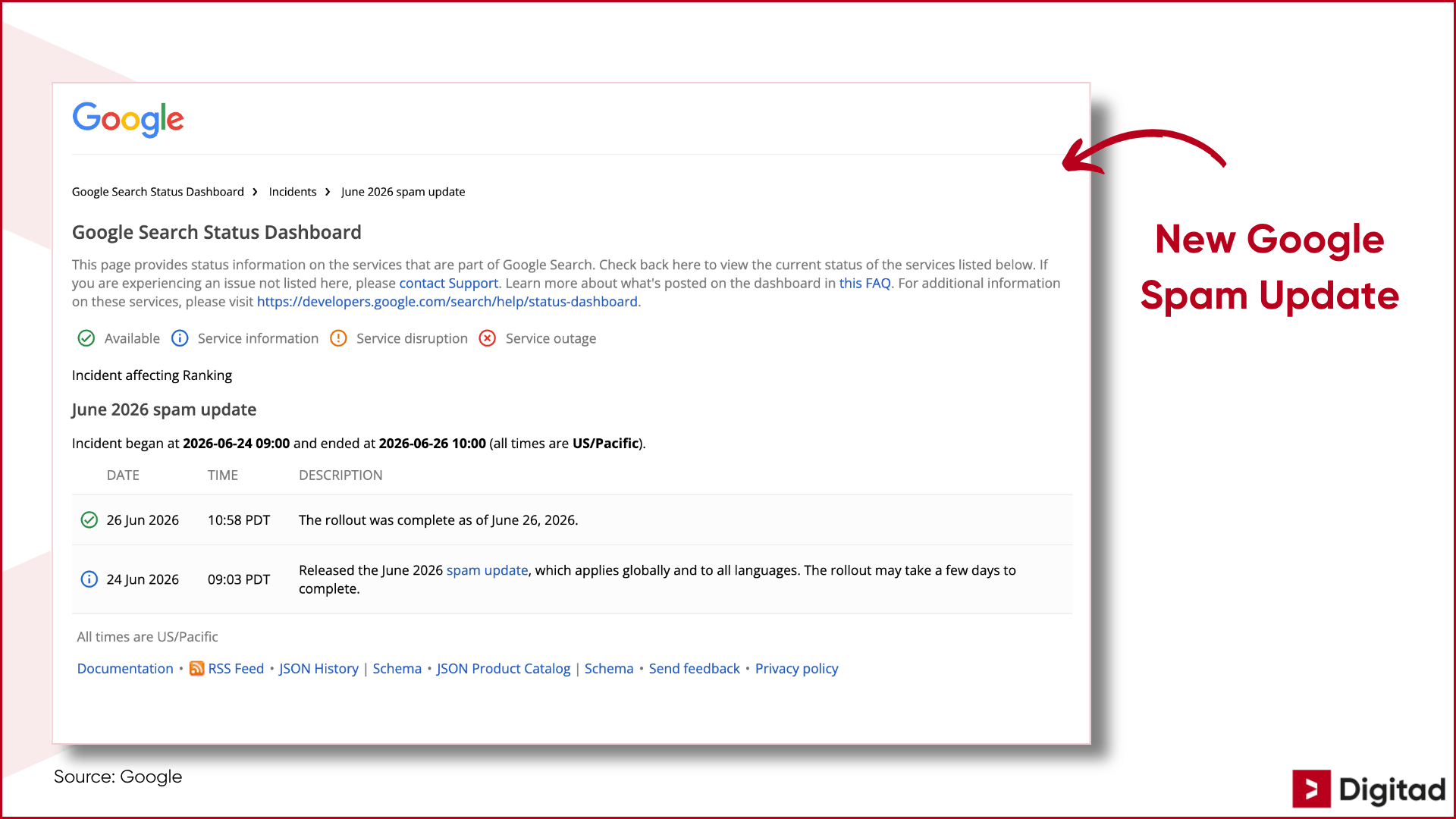
At the end of last month, Google rolled out its latest Spam Update.
And it was completed in JUST 2 days… worldwide… across all languages!
An express rollout, even for Google 🤯
So, what does it mean? For the first time, Google is treating manipulated citations in AI-generated answers the same way it treats classic link spam (meaning, basically, like garbage).
The shift from SEO to GEO + SEO (which our GEO agency has already been talking about for months) just became even more obvious.
We’re not leaving you empty-handed either. We’ve prepared 5 concrete (and effective 😉) tips to help you navigate all of this.
Before diving into the tips, let’s quickly break down the news… 👀
What’s the Latest Google Spam Update?
The latest update was completed on June 26th. It’s the second spam update of 2026 (the first one happened in March). Google now uses its AI-based SpamBrain system to detect and penalize specific manipulative techniques.
For example:
- Scaled content abuse (mass-producing low-value content)
- Cloaking (showing different content to search engines and visitors)
- Sneaky redirects
- Scraped content (copied from other sources)
- Hidden text
No new anti-spam policies were introduced. What changed is the scope of these already-known policies, now extended to AI-generated citations.
What Now Counts as Spam
In practice, Google’s Search spam policies say that if a brand tries to artificially manipulate how it is cited in a generative answer (through fabricated mentions, duplicated content meant to increase its chances of being picked up, or similar tactics already banned in classic SEO), it is now treated the same way as link spam.
This lines up with what the Google GEO guide had already made clear: Generative Engine Optimization still relies on the same foundations as SEO, useful, credible and unmanipulated content, not a new list of tactics to exploit.

All of this is part of Google’s broader goal of delivering more relevant search results to users.
Significant volatility reports had also been observed as early as June 19, with some sites reporting major drops in organic traffic… before the official announcement even happened.
Our 5 Tips to Avoid Being Seen as Spam by Google (and People 😉)
The latest Spam Update doesn’t punish GEO. It punishes attempts to manipulate it.
So creating backlinks isn’t the problem in itself. A serious SEO agency is supposed to build credible authority signals.
The distinction matters: creating content designed to be a strong answer to a real intent is still an excellent strategy. Trying to artificially force a citation is not.
To stay on the right side of this Google update, simply follow these 5 tips:
- Never fabricate brand mentions to try to influence a generative AI, it’s still spam, no matter the platform (ex: creating fake reviews or testimonials to make it look like a brand is cited more often than it really is)
- Avoid duplicated or scraped content in an attempt to multiply your presence in AI answers (ex: copy-pasting the same page and publishing it 4 times while changing only 2 or 3 keywords between each version)
- Focus on original, distinctive content with a real point of view, rather than volume (ex: sharing an analysis based on your own data or turning client observations into useful, precise and actionable advice)
- Make sure Google and your visitors see the same thing (ex: showing optimized content to robots, but displaying a different version or hiding certain keywords from users)
- Monitor your organic traffic closely in the weeks following an update of this scale, especially if your industry is highly competitive in generative answers (ex: insurance, finance, healthcare, legal, real estate or SaaS, where losing just a few queries can quickly cost you leads)
Our own analysis on AI Overviews impact in Quebec shows just how concentrated organic visibility has already become since generative features arrived, one more reason to avoid any shortcut that could end up costing you 😉
GEO Is Still an Opportunity, Not a Shortcut
For companies investing in organic visibility, this kind of update serves as a good reminder: wanting to be first on Google is fine, but not by skipping steps (well, at least not if you wanna avoid turning your GEO strategy to ashes 😅).

At the end of the day, foundations remain the same as with good old SEO. Only the surface of application is expanding (okay… in reality, it’s a little more nuanced than that, but you get the point).
👉 Need a hand making sure your content strategy stays on the right side of Google’s rules? Contact our Digital Marketing Agency in Montreal for a free assessment. We’ll be happy to strengthen… and boost your AI visibility! 🏆


