



GSO, AIO, GEO, AEO, WTVEO… Getting the SEO industry to agree on one term has felt like herding cats. For over a year, it’s been stacking acronyms to describe the same obsession: optimizing visibility in AI.
But last Friday (May 15), the search giant finally drew a line 👀
Yep, Google officially weighed in!
The winning terms? GEO & AEO (the first is for generative engines, the other for answer engines).

And Google didn’t just clarify the vocabulary. It published its very first official guide dedicated to optimizing websites for its generative features in Search (including AI Overviews and AI Mode) 🤯
So… What does it say?
Pretty much what our SEO agency has been repeating for the past few months 😉 GEO is still SEO, generic content is losing value, and technical foundations still matter.
Beyond that, Google also cleared up a few grey areas that were still floating around (like llms.txt files, on-page chunking, etc.).
Let’s take a closer look… 🔍
What doesn’t help with GEO for Google
Before chasing the next “GEO hack”, let’s highlight what does not help with Generative Engine Optimization for Google (so you avoid wasting time on the wrong things) 🙌
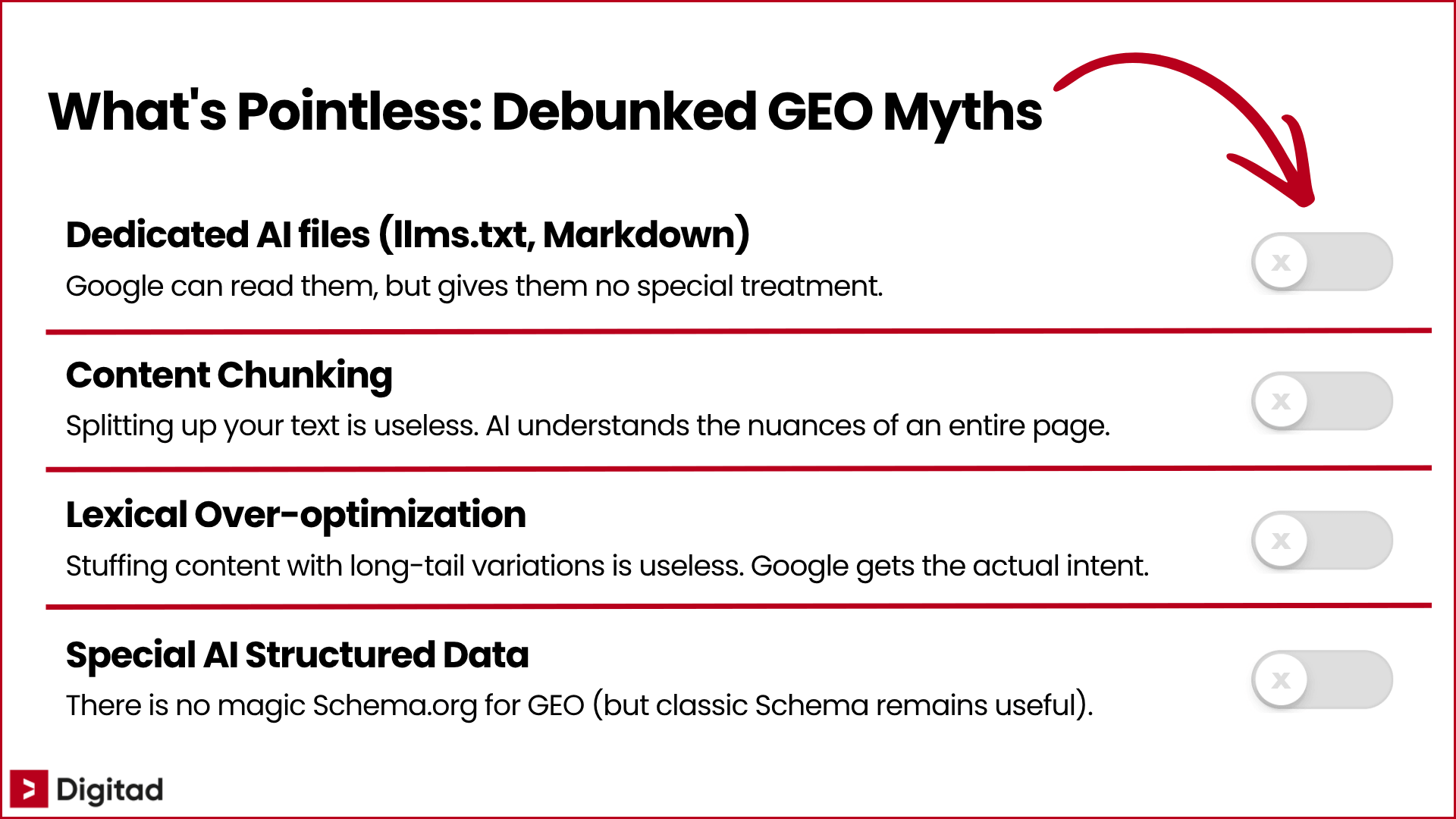
💡 Important nuance: Google is talking about Google Search here. That doesn’t mean these practices will never have an impact in other AI systems like ChatGPT, Perplexity or Claude (since they don’t all work the same way).
Myth #1: AI-dedicated files (ex: llms.txt)
You don’t need to create an llms.txt file (an AI text file), Markdown content or special markup to appear in Google’s generative features.
Yes, Google can crawl several types of files. But “Google can read it” does not mean “Google gives it preferential treatment”.
Myth #2: Content chunking
Artificially breaking your content into smaller blocks to help AI “digest” it is not required for Google.
Its systems can understand multiple topics, nuances and relevant passages within a single page. So, the ideal length is not some magic GEO rule. It should mainly depend on the user, the topic and the search intent.
Myth #3: Semantic and lexical over-optimization
There’s no need to rewrite a page specifically for algorithms or stuff it with long-tail variations to capture every possible phrasing. Google says it understands synonyms, broader meaning and closely related intents.
So, the goal is not to repeat the same idea in 12 different ways. It’s to clearly answer the need behind the search.
Myth #4: “Special AI” structured data
There is no magic or secret schema.org markup to appear in AI Overviews or AI Mode.
That said, important nuance: structured data still matters for classic SEO and rich results. It may not be specifically required for generative search, but it still strengthens the SEO foundation Google relies on.
And to appear in generative features, a page first needs to be indexable and eligible to appear in Google Search with a snippet.
GEO best practices confirmed by Google
Once the fake shortcuts are out of the way, Google comes back to a pretty clear logic:
To be used by Google’s AI, you first need to be a useful, accessible, well-structured and credible source.
1. Non-commodity content
This is probably the most important point in the guide: Google wants non-commodity content.

In other words: content that could not come from just anyone.
Not a clean rewrite of the same generic ideas already available everywhere, but content with a real point of view, human expertise, first-hand experience, concrete examples or original data.
Put simply: if AI could produce almost the same article by summarizing 10 average pages, your content probably isn’t distinctive enough.
2. Technical health (crawl, indexing and JavaScript)
For Google, GEO still relies on technical SEO foundations.
Why? Because Google’s generative features use RAG (Retrieval-Augmented Generation), meaning they rely on pages retrieved from Google’s classic index to generate more reliable and source-backed answers.

Otherwise, Google’s AI will not magically compensate.
3. Visual structure and semantic HTML
Google still recommends a structure designed for human reading: clear paragraphs, logical sections and useful headings.
Not because H2s and H3s are a magic AI formula, but because a well-organized page is easier to read, understand and analyze.

Semantic HTML also supports accessibility, especially for screen readers, and can help Google interpret the page more effectively.
4. High-quality media (images and videos)
As discussed in our article about Gemini Embedding 2, GEO goes well beyond just text. Google reminds us that its generative features can also surface relevant images and videos.

That means screenshots, charts, explainer videos, product visuals and demos can become real visibility entry points, as long as they are useful and optimized according to classic SEO best practices.
5. E-commerce and local optimization
For e-commerce and local businesses, Google clearly mentions Merchant Center, product feeds and Google Business Profiles.

That means generative answers can also rely on business data: products, prices, availability, services, local information, business profiles and more.
So, GEO does not only happen through blog articles. It also depends on clean, complete and up-to-date commercial data.
6. Agentic experiences
Google also introduces agentic experiences, meaning AI agents that can browse, compare, book or buy on behalf of the user.

This may not be the most urgent priority for everyone yet, but for transactional websites, it’s definitely something to keep an eye on: clean DOM structure, strong visual rendering, solid accessibility and emerging protocols like the Universal Commerce Protocol.
Bad GEO practices confirmed by Google
Here, Google is not just saying “this doesn’t help”. It is also calling out practices that can become problematic, especially when they aim to manipulate rankings or generative answers:
We’re thinking of things like:

That’s why, in your content writing, you need to avoid:
1. Mass targeting query variations (scaled content abuse)
With query fan-out, Google can generate several sub-queries in the background to answer a complex question more effectively.

But be careful: this does not mean you should create one page for every micro-variation.
Producing pages at scale to target every possible sub-query can fall under scaled content abuse, which means it may violate Google’s spam policies.
Cover the intent? Yes. Industrialize nearly identical pages? No.
2. Fake brand mentions (inauthentic mentions)
Yes, generative features can reflect what is being said across the web: blogs, videos, forums, discussions, reviews and more.
But artificially creating mentions, comments or reviews to influence AI is not a valid strategy. Google reminds us that its quality and anti-spam systems still apply.
So no, spamming Reddit or forums to “feed the AI” does not suddenly become GEO. It’s still spam, just with a new coat of paint.
3. Raw AI content with no added value
Using AI to help create content is not forbidden.
What becomes a problem is publishing generic, unsupervised content with no human expertise, no angle, no real usefulness and no added value. The issue is not the AI tool. The issue is interchangeable content.
4. Duplicate content
Multiplying similar pages hurts the user experience and wastes crawl budget on low-value URLs.
For Google, fewer weak pages and more truly distinctive, relevant and well-structured pages is the better approach. Even with AI, more content does not mean more value.
Ready? Get set… Let’s GEO!
AI Overviews’ impact in Quebec doesn’t spell the end of SEO. Google is simply burying lazy GEO.

For Google Search, good GEO looks a lot like more mature SEO: expert content, clear structure, solid technical foundations, useful media, clean e-commerce and local data, authentic brand signals and gradual preparation for AI agents.
In short, Google is asking brands to become better sources ✅
👉 Need a hand adapting your SEO strategy to the new realities of AI search? Contact us to discuss it during a free assessment. Our GEO agency would love to help you boost your organic visibility… and your ROI! 😉