

About 2 years ago, AI Overviews started taking over Google’s SERP and, since then… Positions 4 to 10 have lost around 70% of their click share!
That’s right, 70%
The search results page no longer holds the same value it once did.
For our Montreal SEO agency (and the businesses we work with), this raises some very real questions: are people even still clicking on organic results? Is the behaviour and impact of AIOs observed in Quebec the same as in other markets (like the US)?
And most importantly, where are those clicks actually going today?
⚠️ Spoiler: to the Top 3 (and to AI 🙃)! According to our study, the first three organic positions now capture almost 9 out of 10 organic clicks in Quebec 🤯
And that’s without factoring in all the visibility now happening directly inside AI Overviews (which, according to Search Engine Journal, appear on 42% of Google queries and reduce organic clicks by 38%).

To answer this using data from our own backyard, our team of experts analyzed 10.4 million clicks and 54 million impressions from 419 websites owned by Quebec-based SMEs over a 16-month period (October 2024 to January 2026).
Let’s take a closer look… 🔍
Study summary
Digitad’s 2026 State of AI Overviews Impact on SEO in Quebec Report looks at how organic clicks spread across Google’s first page, as AI Overviews, ads, local results and other SERP features take up more and more space.

Why? Our SEO strategists and digital marketing consultants wanted to understand exactly how traffic is being redistributed in Canada’s French-speaking province (using Quebec-first data, then comparing it against major US and international benchmarks).
This analysis shows that page one is no longer a level playing field. Top positions still capture a massive share of clicks, but positions 4 to 10 have lost a huge chunk of their former value.
On top of that, a large share of traffic is now going to “zero-click” searches (which reportedly rise from 54% to 72% when an AIO appears, according to Search Engine Journal).
In fact, did you know that SERPs with Ads + AI Overviews increased by more than 394% last year?
Attention is now turning toward AI Overviews themselves (where being cited generates 120% more clicks per impression than not being cited, according to Seer Interactive).
To drive meaningful organic traffic today, businesses need to compete for top 3 positions, target long-tail searches, build stronger brand awareness and create clear, structured, credible content that AI-generated answers are more likely to cite.
6 Key Findings
89.2% of page one clicks go to the top three results
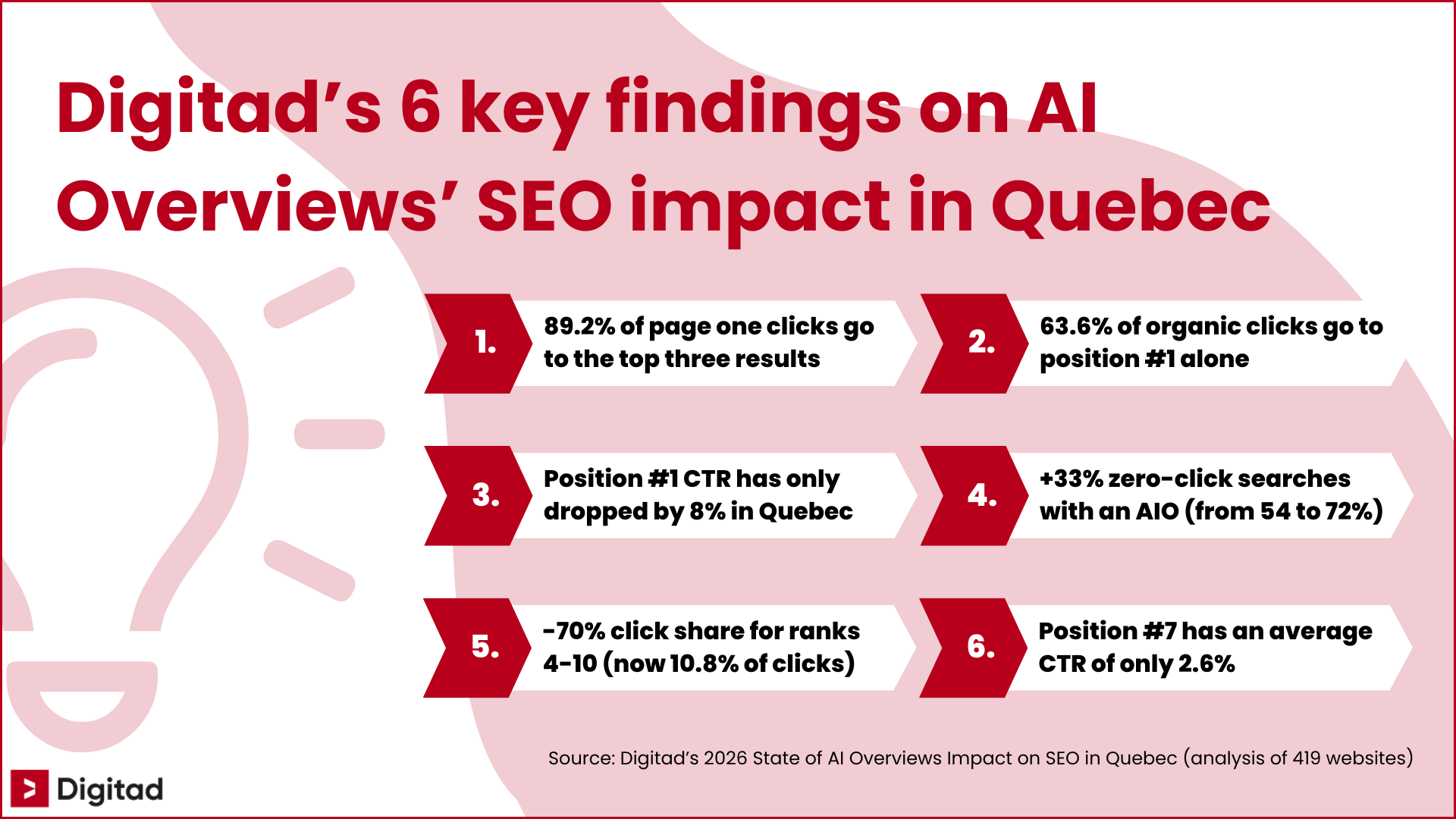
The first three organic results now capture (almost) 9 out of 10 clicks on Google’s first page.
63.6% of organic clicks go to position #1 alone
The first position dominates page one. On its own, it captures nearly two thirds of the organic clicks observed.
Position #1 CTR has only dropped by 8% since AI Overviews arrived in Quebec
Position #1 CTR is about 8% lower since AI Overviews arrived in Quebec. By comparison, Ahrefs and Semrush report click drops of up to 58% internationally.
Zero-click searches rise from 54% to 72% when an AI Overview appears
AI Overviews don’t just push clicks higher up the SERP… they can also make users less likely to click out of Google! Search Engine Journal confirms our findings: zero-click searches increased from 54% to 72% when AI Overviews were displayed (meaning they drive 33% more zero-click searches and 38% fewer clicks to organic links in the SERP).
Before AI Overviews arrived, these positions generally represented between 30% and 45% of click share. Today, they represent only 10.8% (about 3.5 times less than before).
Position #7 has an average CTR of only 2.6%
Being visible on page one no longer guarantees meaningful traffic. In position #7, only about 2.6 impressions out of 100 generate a click.
Methodology at a Glance

Our web analytics agency, Digitad, analyzed Google Search Console data stored in our internal data warehouse, affectionately dubbed the “BRAIN” 🧠
The data was grouped by organic position, then analyzed through two main lenses: average CTR per position and the share of page one clicks captured by each position.
The study covers:
- 419 websites belonging to SMEs in Quebec (Canada)
- 10.4 million clicks
- 54 million impressions
- Both French and English websites
- Organic results on page 1 (positions 1 through 10)
The data spans over a 16-month period, from October 2024 to January 2026 (post-AI Overviews rollout).
Result #1: Page 1 has become a three-spot podium

What data shows us
The top three positions capture 89.2% of all organic clicks on page 1:
| Position on Google (rank number) | CTR (%) | Click Share (%) |
|---|---|---|
| 1 | 36,0% | 63,6% |
| 2 | 21,5% | 16,5% |
| 3 | 12,8% | 9,1% |
| Top 3 (combined) | 70,3% | 89,2% |
The first position stands out dramatically, boasting an average CTR of 36.0% and snagging 63.6% of all organic clicks on page 1.
How to interpret this result
Organic clicks haven’t vanished. They have consolidated. Users are still clicking, but they’re almost exclusively doing so on the very top links.
As the screen gets increasingly saturated with AI Overviews, ads and local results, the same organic position no longer gets the same level of exposure it used to.
“The biggest shift isn’t that people have stopped clicking. It’s that they aren’t clicking as far down the results, and they’re no longer searching exclusively on Google. They’re also turning to social media, forums, and AI engines like ChatGPT. Because of this, businesses need to be far more selective with their SEO efforts and stop treating every position on page 1 as if it holds the same business potential. This is exactly where holistic search comes into play. You have to diversify your channels and invest exactly where the attention, credibility, and real value reside.” — Thomas Joachim, Holistic Search Expert & Performance Director at Digitad
A position 7, 8 or 9 ranking may still look decent on paper, but if it gets very few clicks, its business value remains pretty limited.
Instead of simply aiming for the first page, businesses now need to reach a position that still captures a meaningful share of attention and traffic. And that mostly happens in the top 3 (or through certain SERP features like AI Overviews, FAQs, reviews and the local pack).
TLDR
Page one is no longer enough as an end goal. In many cases, real performance now starts in the top 3 or inside AI Overviews.
Result #2: Position 1 captures more clicks than the rest of page 1 combined

What data shows us
Positions 4 to 10 now capture only 10.8% of all organic clicks on page one.
Here’s how our 2026 data on organic click distribution across Google’s first page in Quebec breaks down:
| Position on Google (rank order) | CTR (%) | Click Share (%) |
|---|---|---|
| 1 | 36,0% | 63,6% |
| 2 | 21,5% | 16,5% |
| 3 | 12,8% | 9,1% |
| 4 | 9,7% | 4,0% |
| 5 | 7,1% | 2,4% |
| 6 | 5,6% | 1,9% |
| 7 | 2,6% | 1,1% |
| 8 | 3,4% | 0,8% |
| 9 | 2,5% | 0,5% |
| 10 | 3,8% | 0,1% |
| Top 3 (combined) | 70,3% | 89,2% |
| Pos 4 to 10 (combined) | 34,7% | 10,8% |
Position #7 perfectly illustrates the issue: despite being on page one, its average CTR barely reaches 2.6%.
How to interpret this result
The gap between first position and the rest of the page is MASSIVE.
With 63.6% of clicks, position 1 captures more clicks on its own than all the other positions combined. It also generates almost six times more clicks than positions 4 to 10 combined (which only capture 10.8%).
In other words, roughly two out of three people who click an organic link choose the very first one.
This changes how SEO progress should be evaluated. Moving up a few positions is still a good sign, but what really matters is where you end up.
“The real habit people need to break is optimizing every keyword as if they all hold the same potential. A query might look great on paper, but if the Top 3 is out of reach, the SERP is saturated, or the search intent is too vague, the best SEO decision might actually be to pivot and change your angle.” — Florian Valloire, SEO & GEO Director at Digitad
Investing heavily in highly competitive queries to reach position 6 or 7 can still be strategically valuable, but less so when the main goal is to generate short-term organic clicks.
TLDR
Middle positions still exist, but they’re shadows of their former selves. SEO must be judged by actual traffic, not vanity rankings.
For marketing teams, that means prioritizing keywords where cracking the top 3 is actually realistic.
Result #3: The Drop for Positions 4-10 Hits Roughly 70%

What data shows us
Strong SEO really does make a difference!
The proof is in the pudding 🥮
While Ahrefs and Semrush both report a 58% CTR drop for the top position internationally, our data shows a drop of only 8% (before vs. after AIOs arrived).
For the rest of the page, though, the drop is a slap in the face:
| Positions | Before (2022-2023) | After (2024-2026) | Average difference (points) | Relative variation (%) |
|---|---|---|---|---|
| CTR Position 1 | 39-44% | 36,0% | ≈ -5,5 pts | -8% |
| CTR Position 4-5 | 12-15% | 8,4% | ≈ -5,1 pts | -38% |
| CTR Position 6-10 | 4-8% | 3,6% | ≈ -2,4 pts | -46% |
| Click Share Top 3 | 55-70% | 89,2% | ≈ +26,7 pts | +27% |
| Click Share Pos 4-10 | 30-45% | 10,8% | ≈ -26,7 pts | -70% |
Note: average differences are based on the “before” ranges compared with the recorded “after” values. Relative variations correspond to the exact changes recorded.
How to interpret this result
AI Overviews have not reduced organic visibility evenly. They mainly amplify the value of the top positions.
The problem is that positions 4 to 10 can still offer visibility, but they don’t bring back as much usable traffic as before, making them less profitable.
That doesn’t mean SEO is becoming useless (quite the opposite). SEO fundamentals matter more than ever, but Google is becoming more demanding.
Businesses must continue to strengthen their SEO foundations, while also adapting their tracking processes and dashboards:
- A keyword no longer has the same value at the same position as it did before
- A ranking increase is only truly useful if it turns into clicks, qualified visibility or opportunities to be cited by AI
- Content must be designed to be found, understood, cited and chosen
- Strategies now need to combine SEO, GEO, long-tail keywords and brand awareness
The goal is no longer just to be found. It is to rank high enough to get clicked, be credible enough to become a reference source and be clear enough to be reused by AI.
TLDR
The drop doesn’t hit all rankings equally, and the SERP has become hyper-competitive. Not only is content flooding the SERP (thanks to generative AI), but positions 4 to 10 are now almost worthless from a business perspective.
It’s not rocket science: more competitors + fewer spots on the podium = much harder to capture qualified organic traffic.
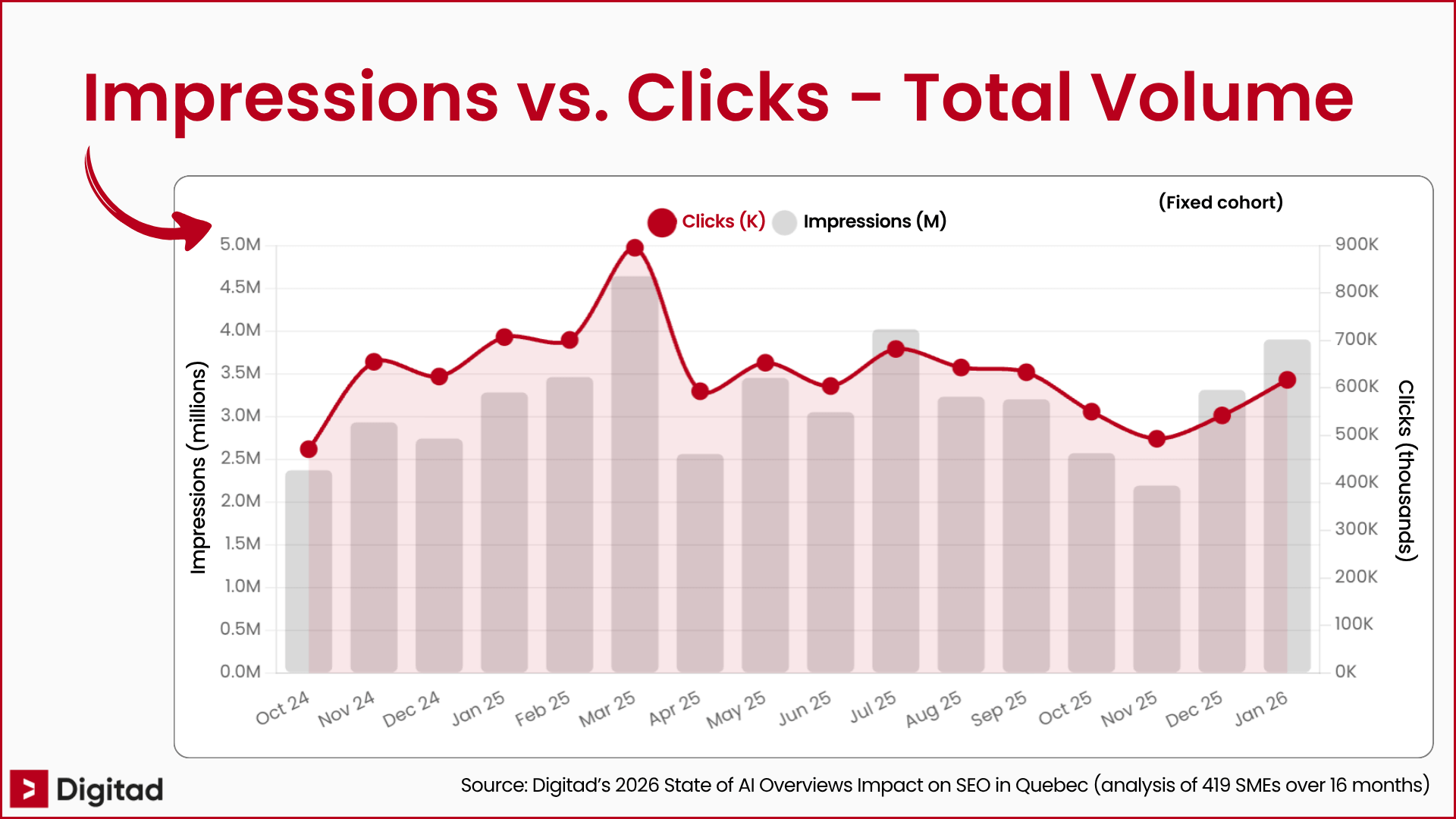
Result #4: The Click Concentration Seems Permanent Over 16 Months

What data shows us
This isn’t just a temporary, post-launch hiccup.
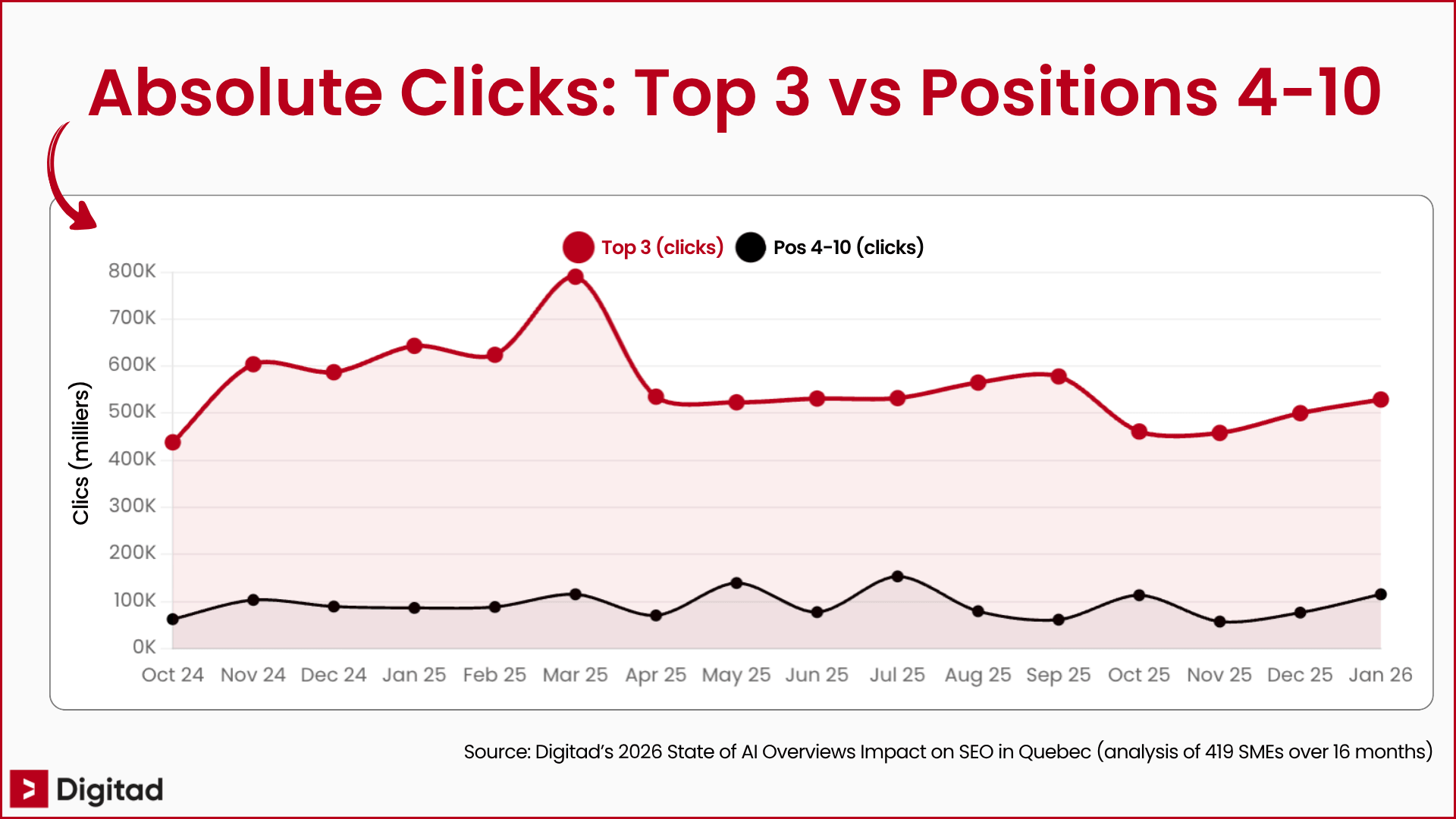
Across 16 months, CTR for the top 3 remained consistently stable, hovering between 26.77% and 33.51% (depending on the month).
This CTR stability is also reflected in the overall click distribution:
| Month | CTR Top 3 | CTR Position 4 and 5 | CTR Positions 6 to 10 |
|---|---|---|---|
| October 2024 | 26,77% | 7,81% | 3,40% |
| November 2024 | 28,72% | 8,42% | 3,20% |
| December 2024 | 28,98% | 9,77% | 4,32% |
| January 2025 | 29,42% | 8,46% | 4,75% |
| February 2025 | 28,99% | 9,39% | 4,40% |
| March 2025 | 27,62% | 6,93% | 5,46% |
| April 2025 | 30,24% | 9,45% | 5,97% |
| May 2025 | 28,71% | 9,45% | 7,30% |
| June 2025 | 27,84% | 9,07% | 4,71% |
| July 2025 | 28,45% | 9,10% | 5,54% |
| August 2025 | 30,84% | 9,76% | 3,24% |
| September 2025 | 33,51% | 8,79% | 2,13% |
| October 2025 | 30,35% | 17,47% | 5,86% |
| November 2025 | 31,41% | 11,22% | 3,00% |
| December 2025 | 28,97% | 11,47% | 1,94% |
| January 2026 | 31,85% | 13,68% | 2,29% |
As you can see, the top 3’s click share remained sky-high throughout the period, generally sitting between 87% and 90% (with a couple of monthly fluctuations).
Here’s another monthly view of the collected data, this time comparing the top 3 against the rest of the first page:
| Month | Click Share for the Top 3 | Click Share for positions 4 to 10 |
|---|---|---|
| October 2024 | 87,7% | 12,3% |
| November 2024 | 85,4% | 14,6% |
| December 2024 | 86,8% | 13,2% |
| January 2025 | 88,2% | 11,8% |
| February 2025 | 87,6% | 12,4% |
| March 2025 | 87,3% | 12,7% |
| April 2025 | 88,5% | 11,5% |
| May 2025 | 79,0% | 21,0% |
| June 2025 | 87,3% | 12,7% |
| July 2025 | 77,7% | 22,3% |
| August 2025 | 87,7% | 12,3% |
| September 2025 | 90,4% | 9,6% |
| October 2025 | 80,3% | 19,7% |
| November 2025 | 88,9% | 11,1% |
| December 2025 | 86,8% | 13,2% |
| January 2026 | 82,2% | 17,8% |
How to interpret these results
If this click concentration were just a temporary setback, we probably would’ve seen positions 4 to 10 rebound after a few months.
The data shows no such thing.
“When you see the same behavior repeat over and over for 16 months straight, it’s no longer a temporary trend. It’s a new reality. And businesses need to start building that reality into their strategies and analysis models immediately. Or better yet, yesterday.” — Alexandre Corbasson, Collective Integral’s Co-founder, Associate & CEO at Digit
Despite monthly fluctuations, the top 3 kept capturing the vast majority of clicks throughout the 16-month period, reshaping the dynamics of page one.
Quebec marketing teams and businesses should already be adapting:
- Their ranking objectives
- Their organic performance reports
- How they interpret CTR
- Their content priorities
- How they balance efforts across generic keywords, long-tail keywords, GEO and brand awareness
The question is therefore no longer just: “Are AI Overviews changing the value of organic positions?”
But rather: “How do we adapt our strategy now that this traffic redistribution already seems to be established?”
⚠️ WARNING… Clicks aren’t disappearing, they’re being redistributed! Some studies show that AI Overviews increase zero-click searches when they appear on certain queries. However, by comparing the same keywords before and after AI Overviews appeared in SERPs, Semrush found that the zero-click rate actually decreased from 33.75% to 31.53%.
TLDR
The click monopoly of the top 3 isn’t wearing off. It held steady across 16 months of data. No rebound. No market correction. This is the new normal.
For businesses, this is NOT a signal to wait on passively, but a reality to start integrating into their SEO analysis right NOW.
What These Results Mean for Quebec Businesses Like Yours
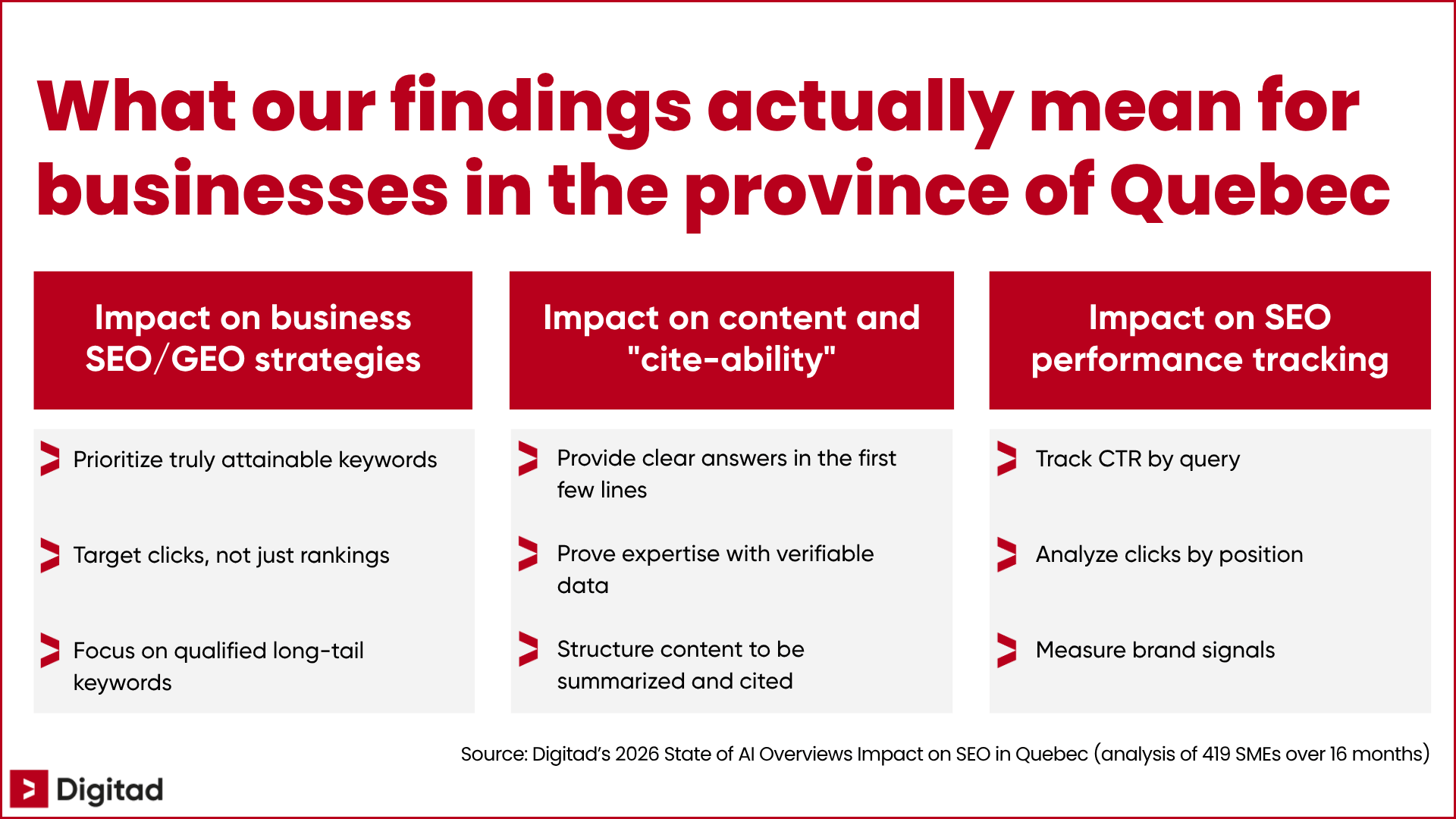
Impact on SEO strategy
Not every query deserves the same level of effort. If a business cannot realistically reach the top 3 for a highly competitive keyword, it may be more profitable to target more specific, less competitive queries that are closer to its customers’ real intent (long live the long tail!).
It’s no longer about simply accumulating page one keywords, but identifying the ones that will actually generate clicks, leads or sales.
Impact on content and citability
AI Overviews don’t kill content. They force it to level up. In a saturated market where users are already drowning in information, it has never been more important to be clear, structured and credible.
In this new context, content needs to:
- Answer the user’s question quickly
- Present verifiable information
- Include original data whenever possible
- Demonstrate real expertise
- Be easy to understand, summarize and cite
This is exactly where Generative Engine Optimization (GEO) comes into play. It helps you build content for Google’s traditional search results and its generative AI layer.
Impact on performance measurement
Your SEO reporting needs an upgrade.
An average position or page-one ranking is no longer enough to evaluate the real performance of a piece of content.
Teams should also look at:
- Real CTR by query
- Click share by position group
- Pages that still generate qualified traffic
- Queries where the top 3 is achievable
- Queries where traffic is dropping despite stable rankings
- Brand signals and direct queries
To properly manage SEO in 2026, teams should not only adapt their SEO tracking, but also measure GEO performance in their dashboards.
Let’s talk solutions: 7 SEO Tips from Digitad’s team
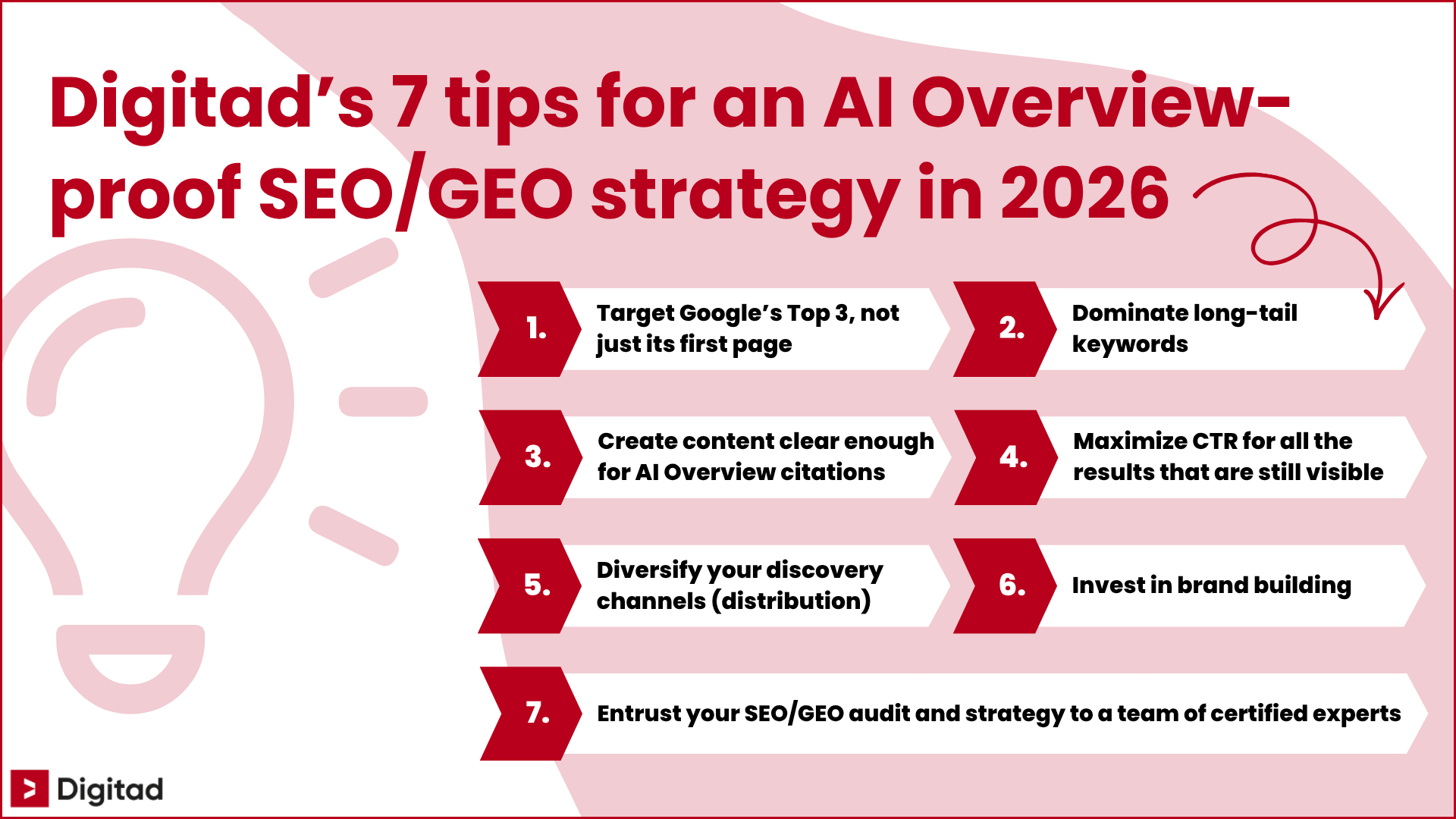
Tip #1: Aim for the Top 3, not just page 1
Page 1 should no longer be your finish line.
If a query can’t realistically reach the Top 3, you have to ask yourself whether it’s still worth the effort. In some cases, it may even be smarter to reallocate resources toward queries that are more targeted, more accessible, or closer to conversion.
Tip #2: Dominate long-tail keywords
If the Top 3 has become essential, the long tail becomes even more strategic.
It’s often much better to rank #1 for several highly precise queries than to sit at #6 for a highly competitive generic keyword. Long-tail queries might generate lower individual search volumes, but they often carry clearer search intent and offer a better chance of reaching the top positions.
Tip #3: Create content clear enough to be cited by AI Overviews
AI Overviews display sources. To boost your chances of being picked up, your content must be exceptionally easy to read, understand, and extract.
This requires:
- Answer-first content
- Clear Hn headings
- Hard data and statistics
- Precise definitions
- Useful lists and comparison tables
- Concrete examples
- Demonstrable expertise
- Solid proof of credibility
- Structured data (schema markup)
- Low or no JavaScript
Being cited in an AI Overview doesn’t always guarantee a click, but it can significantly boost your visibility, credibility, and brand discovery.
Tip #4: Maximize the CTR of every result still visible
When users’ attention is becoming increasingly scarce, every detail of your snippet matters.
Optimize your title tags, meta descriptions, and structured data. A good ranking is useless if the snippet isn’t compelling enough to earn the click.
Tip #5: Diversify discovery channels
Google remains central, but it’s not the only front door anymore.
Future customers are searching via ChatGPT, Perplexity, Claude, and many other platforms! To remain visible, brands need to build a cohesive presence across several search surfaces. This includes web content, external mentions, social media, user reviews, case studies, proprietary data, and mentions from credible third-party sources.
Tip #6: Invest in the brand
Branded queries are becoming a strategic asset.
The more people search for you by name, the less you rely on generic queries where you’re bleeding resources fighting for the same three spots.
Brand building isn’t separate from SEO anymore. It’s becoming a critical lever to protect your market share and strengthen your organic performance.
Tip #7: Entrust your SEO/GEO audits and strategy to experts
In a world where rankings don’t carry the same weight they used to, your audit shouldn’t stop at checking positions.
To separate what can actually drive traffic from what might only drain your budget, it should also evaluate:
- The real value of your targeted positions
- Your potential to reach the Top 3
- Your visibility in AI answers
- Content quality
- Queries where your brand can become a credible source
- Conversion opportunities
- Etc.
It may feel like a lot, don’t worry! That’s exactly where an SEO and GEO agency proves its worth.
Not only do they have the tools and experience to spot the gaps between where your visibility is today and where you want it to be, but they can also turn that insight into a realistic roadmap built around your goals, resources, and market reality.
Ultimately, the audit becomes more than a simple SEO diagnosis. It turns into a strategic decision-making tool.
👉 Ready to entrust your SEO/GEO audit to our certified experts? Check out our SEO pricing and packages (or contact us today for a free evaluation!) 👀
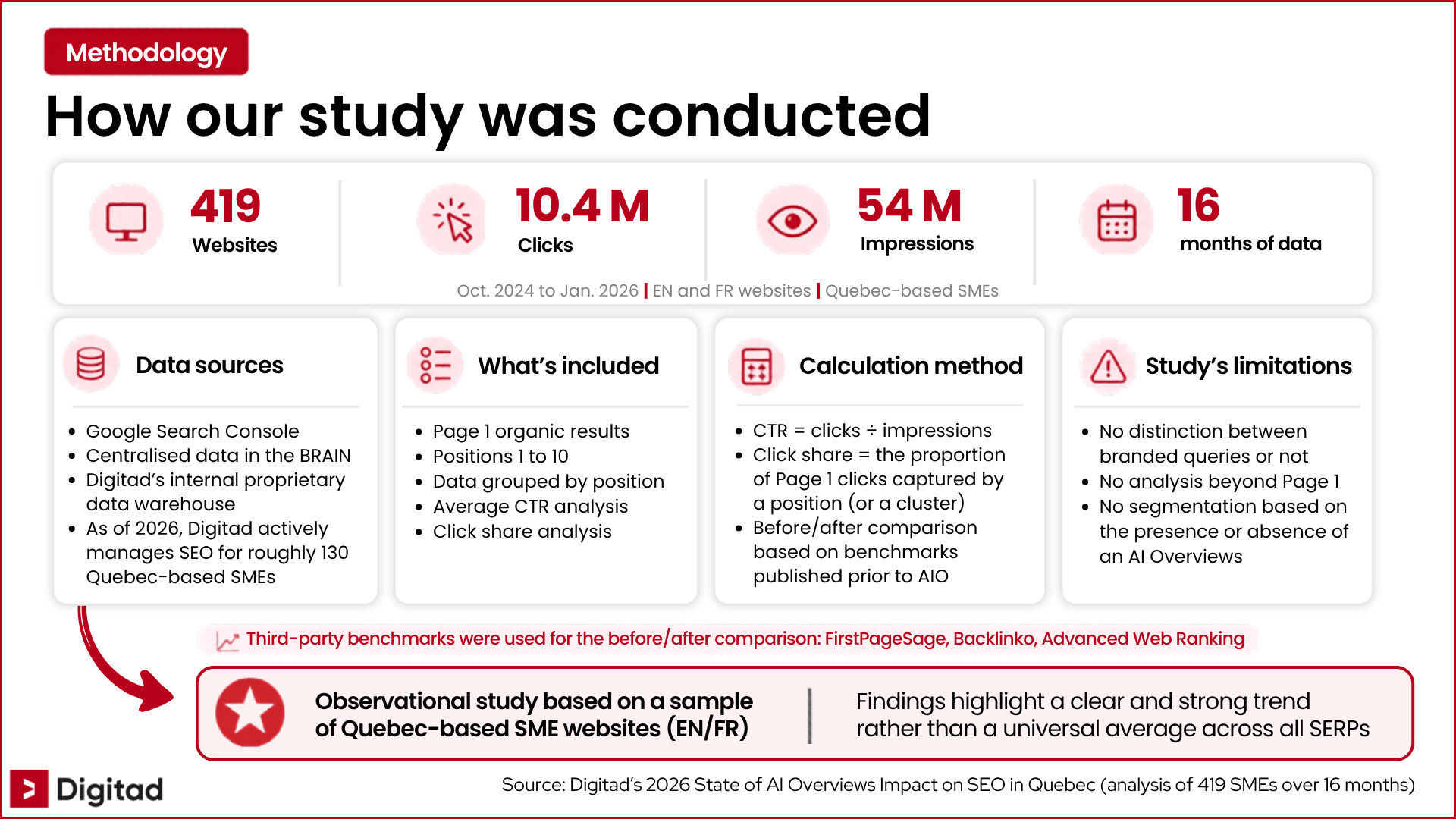
Full Methodology & Limitations
Data sources
The data comes from Google Search Console and is centralized in the BRAIN, our internal data warehouse.
Digitad, our GEO agency, actively manages SEO for around 130 Quebec-based SMEs. We use this infrastructure to centralize, compare, and analyze our clients’ organic performance.
Analyzed sample
The study covers:
- 419 websites owned by Quebec-based SMEs
- Both French and English websites
- 10.4 million clicks
- 54 million impressions
- A 16-month period, from October 2024 to January 2026
Inclusion criteria
- The analysis includes organic results on Google’s first page, meaning positions 1 to 10
- The data was grouped by position to compare average CTR and the click share captured by each position
Calculation methodology
- CTR corresponds to the number of clicks divided by the number of impressions
- Click share corresponds to the proportion of clicks captured by a position or group of positions compared with all clicks observed on page 1
- For the before/after comparison, Digitad’s current data was compared with benchmarks published by third parties, including FirstPageSage, Backlinko, and Advanced Web Ranking
- When our data was compared to external benchmarks (whether from SE Ranking, Semrush, Ahrefs, Search Engine Journal, or others), we explicitly mentioned the source. When nothing is mentioned, the data comes from the current study presented on this page.
Biases and interpretation notes
- The results reflect the behaviour observed across a sample of Quebec websites, mainly SMEs
- They should not be interpreted as a universal average across all SERPs, markets or industries
- They do, however, point to a strong trend: the value of organic traffic on page 1 is becoming increasingly concentrated in the top positions, while middle positions generate fewer clicks than before
Study limitations and exclusions
Like any study based on real-world data, this analysis should be read with some precautions, including:
- Scope: The study focuses only on Google’s first page (positions 1 to 10). Positions beyond page 1 are not covered.
- Website type: The data comes from Quebec SMEs. Enterprise websites, major media outlets and very high-volume e-commerce sites may behave differently.
- AI isolation: Google Search Console does not yet allow users to isolate queries with AI Overviews. The study measures CTR evolution in a broader post-rollout context, without attributing every variation to a specific AI display.
- Brand segmentation: The study does not distinguish between branded and non-branded queries, since the identification flag is not yet reliable enough in the data warehouse used.
- Geographic context: Quebec’s francophone market may be less exposed to AI Overviews than the US market. The impacts may therefore be less drastic here than in the United States.
In Short: SEO Isn’t Dead, But Page 1 Is No Longer Enough
For a long time, being on page 1 could be considered an SEO win 🏆
It’s no longer that simple.
Our Montreal-based GEO agency’s data shows that, in the era of AI Overviews, the “new page 1” has basically become a three-spot podium.

True, top results still capture most of the clicks, but lower positions are literally getting buried by ads and AI answers.
For businesses like yours, being visible is no longer enough. You need to rank high enough to be clicked, be clear enough to be understood, credible enough to be cited and known enough to be searched by name.
SEO is not dead.
But the “we’re on page 1, so everything is fine” reflex is seriously getting old.
👉 Need a little help navigating AI Overviews’ impact on your website? Contact our digital marketing agency for a free consultation! Our experts would be more than happy to boost your visibility, your leads… and your ROI! 🤩


